

Can a Food Weight Detector measure in milligrams?
As a supplier of food weight detectors, I often encounter questions from customers about the precision and measurement capabilities of our products. One of the most frequently asked questions is whether a food weight detector can measure in milligrams. In this blog post, I will delve into this topic, exploring the technical aspects, limitations, and practical applications of measuring food weights in milligrams using our detectors.
Understanding the Basics of Food Weight Detectors
Food weight detectors are essential tools in the food industry, ensuring product quality, compliance with regulations, and efficient production processes. These devices are designed to accurately measure the weight of food products at various stages of production, from raw materials to finished goods. The accuracy of a food weight detector is typically determined by its load cell, which is a transducer that converts force into an electrical signal. The quality and sensitivity of the load cell play a crucial role in the detector's ability to measure weight accurately.

The Possibility of Measuring in Milligrams
The short answer is yes, some high - precision food weight detectors can measure in milligrams. However, this capability depends on several factors:
1. Load Cell Sensitivity
Load cells with high sensitivity are capable of detecting very small changes in weight. For measuring in milligrams, a load cell with a high resolution and low noise is required. Our company offers a range of load cells with different sensitivities to meet the diverse needs of our customers. For example, our Drop Type Automatic Weighing Machine is equipped with a highly sensitive load cell that can achieve milligram - level accuracy under optimal conditions.
2. Environmental Conditions
The environment in which the food weight detector operates can significantly affect its accuracy. Factors such as temperature, humidity, and vibration can introduce errors in the measurement. To measure in milligrams, it is essential to operate the detector in a stable environment. Our detectors are designed with advanced technology to minimize the impact of environmental factors. For instance, they are equipped with temperature compensation features to ensure accurate measurements even in fluctuating temperatures.

3. Product Characteristics
The nature of the food product being measured also plays a role. Some food products may be prone to static electricity, which can interfere with the measurement. Additionally, the shape and size of the product can affect the accuracy of the measurement. Our Automatic Food Weight Checker is designed to handle a wide variety of food products, with adjustable settings to optimize the measurement process for different product characteristics.
Practical Applications of Milligram - Level Measurement
Measuring food weights in milligrams has several practical applications in the food industry:

1. Ingredient Formulation
In the production of high - end food products, such as fine chocolates or specialty spices, precise ingredient formulation is crucial. Measuring ingredients in milligrams ensures that the product has the desired taste, texture, and quality. Our food weight detectors can be used to accurately measure small quantities of ingredients, helping manufacturers maintain consistency in their products.
2. Quality Control
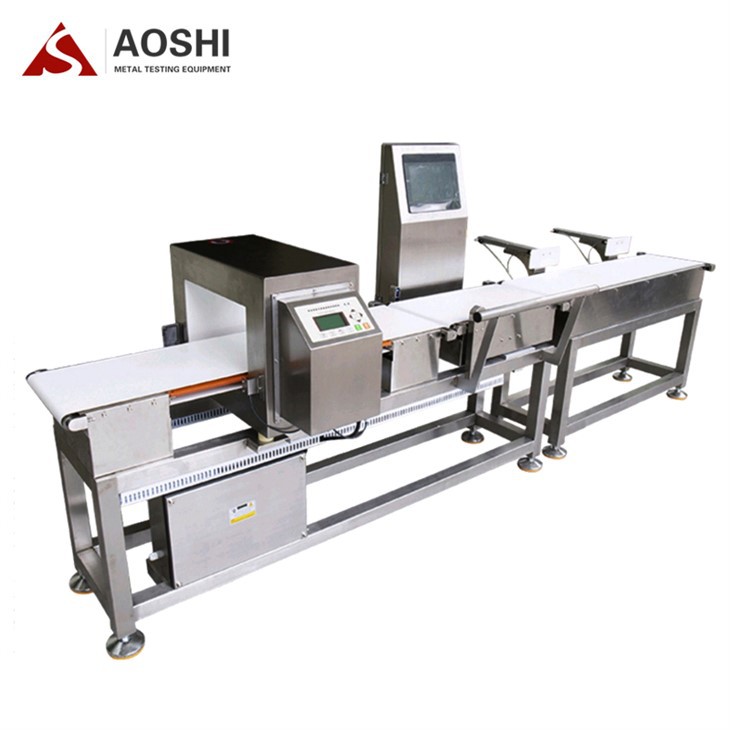
For food products that are sold by weight, such as nuts or candies, milligram - level accuracy is essential for quality control. Our Metal Detector Online Weighing Machine Combined Machine can not only detect metal contaminants but also measure the weight of the product with high precision. This helps manufacturers ensure that each package contains the correct amount of product, reducing the risk of over - or under - filling.
3. Research and Development
In food research and development, accurate measurement of small quantities of substances is often required. Our high - precision food weight detectors can be used in laboratories to measure the weight of new ingredients, test formulations, and conduct experiments. This enables researchers to develop innovative food products with improved quality and functionality.
Limitations and Challenges
While it is possible to measure food weights in milligrams using our detectors, there are some limitations and challenges:
1. Cost
High - precision load cells and advanced technology required for milligram - level measurement can increase the cost of the food weight detector. However, we believe that the investment is worthwhile for manufacturers who require high - quality and accurate measurements.
2. Speed vs. Precision
In high - speed production lines, achieving milligram - level accuracy can be challenging. The faster the product moves through the weighing system, the more difficult it is to obtain a precise measurement. Our engineers are constantly working on improving the design of our detectors to balance speed and precision, ensuring that our products can meet the needs of high - volume production environments.
3. Maintenance
Maintaining the accuracy of a food weight detector that measures in milligrams requires regular calibration and maintenance. Our company provides comprehensive after - sales service, including calibration, repair, and technical support, to ensure that our customers' detectors operate at their best.
Conclusion
In conclusion, a food weight detector can measure in milligrams, but it depends on various factors such as load cell sensitivity, environmental conditions, and product characteristics. Our company offers a range of high - precision food weight detectors that are capable of milligram - level measurement, suitable for a variety of applications in the food industry.
If you are interested in our food weight detectors or have any questions about their capabilities, please feel free to contact us for a detailed discussion and potential procurement. We are committed to providing you with the best solutions to meet your specific needs.
References
- "Principles of Load Cell Technology" by Instrumentation Today
- "Food Quality Control and Weighing Systems" by Food Science Journal
- "Advances in High - Precision Weighing for the Food Industry" by Industry Insights Magazine